
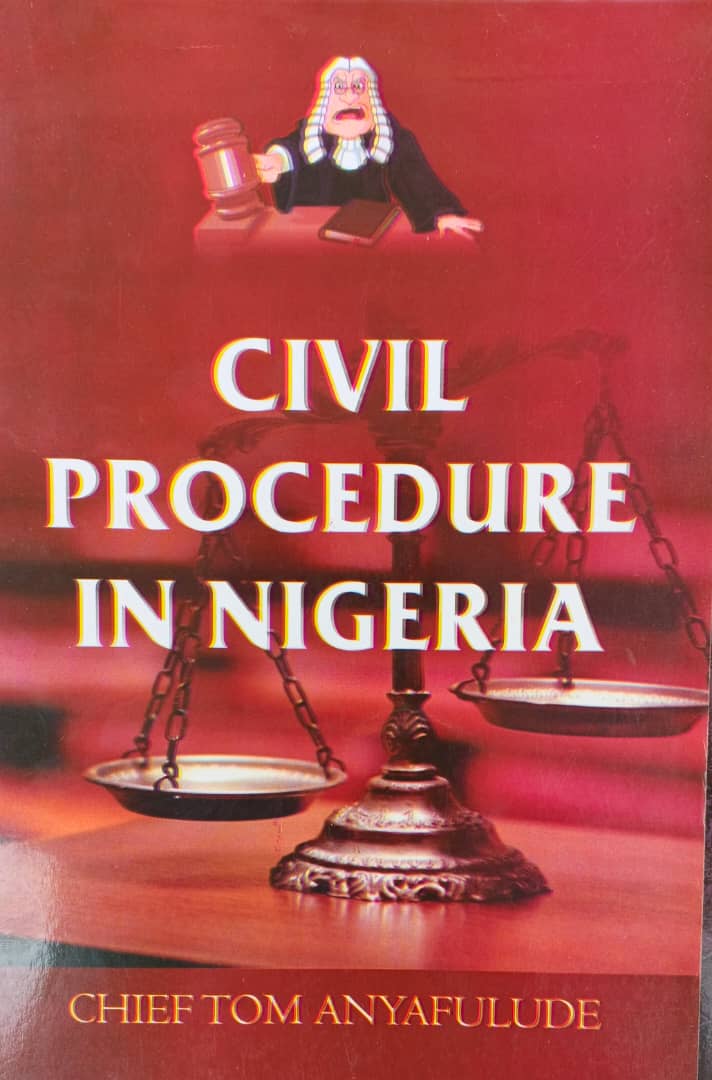
The subject matter of civil proceduredeals with the body of law that sets out, the rules and standards that courts follow, when adjudicating civil law suits. This aspect of our law is of paramount importance to legal practitioners and law students in the Law School. Each State in Nigeria has its own High Court Rules, which provides various subject matters, that constitutes provisions on civil procedure.
This book is titled Civil Procedure in Nigeria and comprises 46 chapters. Each chapter deals with a broad subject matter, e.g. Commencement of actions, service of processes, proceedings at trial, executions of judgement etc. The High Court Rules of Lagos State 2019 is used as a reference point, since the High Court Rules of all the states cannot be considered in one volume. There are no substantial differences between one High Court Rules and another. Recent decisions of the Supreme Court are used as basis and authorities for upholding and justifying any particular position. For instance, the concept of locus standi has been greatly modified by the recent judgement of the Supreme Court. In Centre for Oil Pollution Watch v. Nigeria National Petroleum Corporation (2018) JSCNLR (Vol.17) 29 SC.
Similarly, there have been conflicting Supreme Court decisions on service outside jurisdiction, but we have anchored our opinion on the recent Supreme Court decision in People’s Democratic party (PDP) v. Independent National Electoral Commission (2018) JSCNLR (Vol. 11) 227 SC, which adopted the positon of the Supreme Court in the earlier decision of Skenconsult (Nig) Ltd v. Ukey (1981) 12 NSCC p.1. While dealing with a chapter, we present the reader the opportunity of appreciating the divergent views in judicial authorities, but endeavor to present the latest judicial authority on the subject matter.
Leave a Reply